Software pricing models are the contract structures that decide how you pay for a project and who absorbs the risk if it runs long. Software agencies typically offer three of them: fixed price, time and materials, and dedicated team. Picking the wrong one can cost you flexibility, budget control, or both. Here is how each model actually works, who it fits, and how to choose with confidence.
What Is a Software Pricing Model, and Why It Matters
A software pricing model is the contract structure that decides how scope, risk, and payment are split between you and the development team. It shapes how much flexibility you have to change direction mid-project, how predictable your invoices are, and who absorbs the cost if estimates turn out wrong. Most software development agencies, including DevForc, offer some combination of the three models below, and many projects even blend them across different phases of the same build.
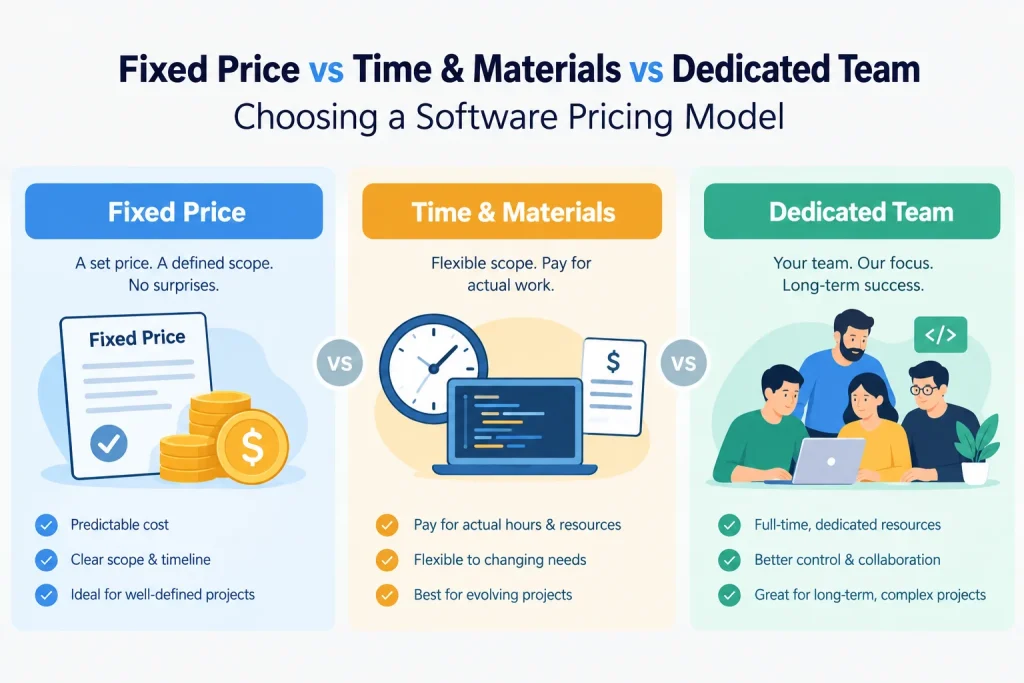
Fixed Price: Best for Well-Defined, Smaller Projects
In a fixed-price software pricing models arrangement, you agree on scope, deliverables, and a total cost before work starts. The agency estimates the effort, builds in a buffer for risk, and then commits to that number regardless of how long the work actually takes.
- Best for: MVPs, landing pages, and small tools with a locked feature list
- Pros: predictable budget, minimal client involvement day to day, low financial risk
- Cons: any scope change usually triggers a costly change order, and quality can suffer if the agency pads estimates to protect margin
Time and Materials: Best for Evolving Requirements
With a time and materials software pricing models arrangement, you pay for actual hours worked at an agreed rate, tracked and billed on a regular cycle, usually weekly or monthly. Scope can shift as you learn more, without renegotiating the whole contract.
- Best for: products still being defined, ongoing feature work, or projects likely to change direction
- Pros: full flexibility to reprioritize at any time, plus a faster start since detailed specs are not required upfront
- Cons: total cost is harder to forecast, and it requires more active client oversight to keep the team focused
Dedicated Team: Best for Long-Term, Ongoing Development
A dedicated team software pricing models arrangement puts a group of developers, designers, and QA specialists under your direction for a fixed monthly rate, functioning like an extension of your in-house staff. You control the roadmap and daily priorities, while the agency handles recruitment, HR, and management overhead.
- Best for: long-term product roadmaps, startups scaling engineering capacity, and companies that need consistent throughput over many months
- Pros: deep product knowledge builds up over time, predictable monthly cost, easy to scale the team up or down
- Cons: requires a longer minimum commitment, and results depend heavily on how well you manage the team day to day
How to Choose the Right Software Pricing Model
Start with two questions: how well-defined is your scope, and how long do you expect to keep building? A short, clearly scoped project favors fixed price, because both sides can commit to a number with confidence. A product that’s still finding its shape favors time and materials, since it lets you adapt as you learn. A long-term roadmap with recurring feature work favors a dedicated team, since it rewards the accumulated product knowledge that builds up over months. Contract structure is consistently one of the top predictors of project cost overruns, according to research from the Project Management Institute, so matching software pricing models to your project’s actual uncertainty matters more than chasing the lowest quoted rate.
Frequently Asked Questions
Can I switch software pricing models mid-project?
Yes. Many teams start with time and materials to nail down scope, then move to fixed price or a dedicated team once requirements stabilize and the roadmap becomes clearer.
Which software pricing model is cheapest?
None is inherently cheaper. Fixed price bakes in a risk buffer, time and materials bills only for actual work performed, and a dedicated team spreads cost predictably over months. The cheapest option is whichever model fits your project’s real level of uncertainty, not the one with the lowest number on the quote.
Final Thoughts
There’s no universally “best” among software pricing models, only the one that matches your project’s scope, timeline, and appetite for risk. Weigh how firm your requirements are today against how much they’re likely to change, and let that answer point you toward fixed price, time and materials, or a dedicated team. If you’re still weighing your options, talk to DevForc about your specific project, and we’ll recommend which of the software pricing models fits.