Every failed software project we have been asked to rescue shares one trait: nobody could produce a document explaining what the software was supposed to do. There were Slack threads, a Figma file somebody abandoned, a contract with a line item called “Phase 1 — Development.” But no shared definition of done.
The software discovery phase is what produces that definition. It is the structured period before a single line of production code gets written, where you convert a business idea into a buildable, costable, testable specification. It usually runs two to six weeks. It usually costs between 5% and 15% of the total project budget. And it is, by a wide margin, the cheapest insurance you will ever buy on a software investment.
What the discovery phase actually is
Discovery is not a sales call with a nicer name. It is a paid engagement with deliverables, run by the people who will build the product — typically a product strategist, a technical architect, a UX designer, and your own domain experts.
The goal is to answer four questions with evidence rather than optimism:
- Who is this for, and what will they do differently once it exists?
- What has to be true technically for that to work?
- What is the smallest version that proves the idea?
- What will it cost, and what could blow that estimate up?
If your development partner cannot tell you which of those four questions each discovery activity serves, they are billing you for meetings.
What happens week by week
Week 1 — Business and user context
Stakeholder interviews come first. Not a single workshop with everyone in the room, where the loudest title wins, but separate conversations with the people who will actually use the software, the people who own the budget, and the people who maintain whatever it replaces.
The output is a problem statement and a list of success metrics. “Reduce order processing time from 40 minutes to under 10” is a success metric. “Modernise our operations” is a wish.
Week 2 — Process and data mapping
Here you map the current workflow, including the parts that embarrass people — the spreadsheet somebody maintains by hand, the WhatsApp group where approvals really happen. Software that ignores shadow processes gets abandoned within a quarter.
Data mapping runs alongside: what data exists, where it lives, what shape it is in, who owns it, and what the migration will look like. This is where most estimate overruns are born. A client once described their customer data as “in the CRM.” It was in two CRMs, a legacy Access database, and 14,000 rows of a shared spreadsheet with inconsistent date formats.
Week 3 — Technical architecture and risk
The architect produces a system design: the stack, the integrations, the hosting model, the authentication approach, the third-party services. More importantly, they produce a risk register — the specific things that could go wrong, ranked by likelihood and impact.
Typical entries: a third-party API with undocumented rate limits, a compliance requirement nobody budgeted for, a legacy system with no export capability, a vendor contract that forbids the integration you planned.
Risks found in discovery cost hours. The same risks found in month four of development cost weeks.
Week 4 — Scope, prototype and estimate
The team converts everything above into a prioritised feature list, splits it into a must-have release and a later backlog, builds a clickable prototype of the core journey, and produces an estimate with a stated confidence range.
A good estimate at this stage looks like “$85,000–$110,000, 18–22 weeks, with the integration to your ERP as the main variable.” A bad estimate is a single number with no range, which means somebody guessed.
What you should receive at the end
Discovery that does not produce artifacts is a consulting bill. Insist on a defined deliverable set:
| Deliverable | What it is for |
|---|---|
| Software requirements document | The shared definition of done — see our SRS guide and template |
| Prioritised feature backlog | What gets built first and what is explicitly out of scope |
| Technical architecture diagram | The system design, stack and integration points |
| Clickable prototype | The core user journey, testable with real users |
| Risk register | Named risks with mitigation and cost impact |
| Estimate with confidence range | Budget and timeline you can take to a board |
| Delivery plan | Sprint structure, team composition, milestones |
Every one of those should be yours to keep. If the discovery output cannot be handed to a different development agency and used, it was not really a specification.
Why skipping it costs more
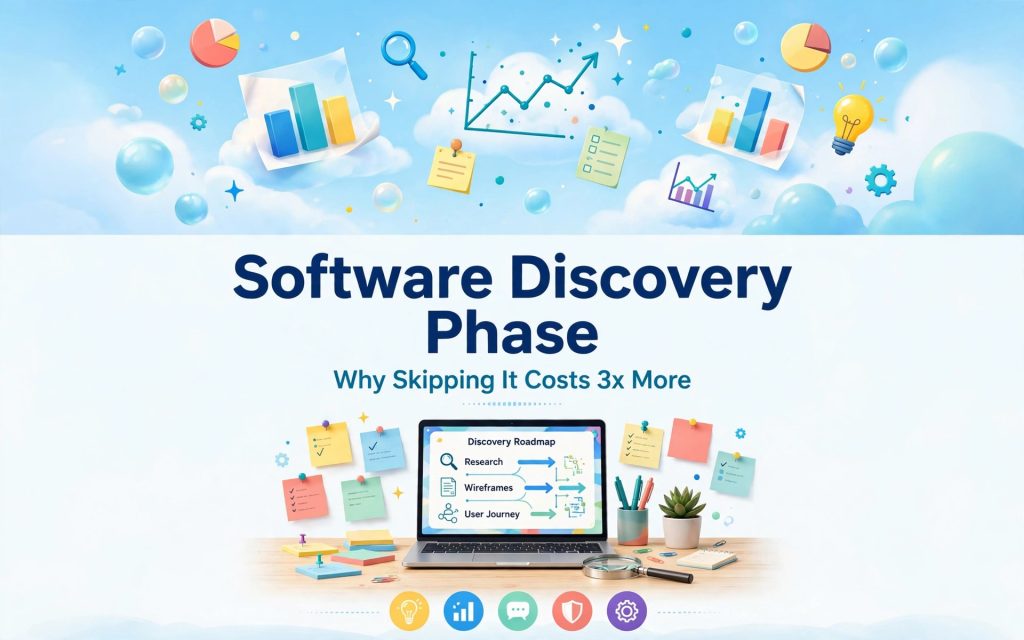
The 3x figure is not marketing. It comes from how defect cost scales across a project lifecycle — a requirement error caught during specification costs roughly one unit to fix; the same error caught during development costs several times that; caught after release, it costs an order of magnitude more, because you are now paying for the wrong feature, the rework, the regression testing, and the user trust you spent.
Three specific failure modes come from skipping discovery:
Scope discovered late. Development starts on a half-understood brief. Requirements surface sprint by sprint. Each one is a change request, each change request is renegotiated at full rate, and the “fixed price” you signed becomes a series of increments. Projects that start without a specification routinely finish 40–60% over their original quote.
Building the wrong thing well. The most expensive outcome is not a late project. It is a project delivered on time, on budget, that nobody uses — because the assumption underneath it was never tested. Discovery’s prototype stage exists to kill bad assumptions while they are still cheap.
No basis to hold anyone accountable. Without an agreed specification, “it does not work the way we wanted” is an opinion, not a contractual position. You cannot dispute what you never defined.
What discovery costs
As a rule of thumb, discovery runs 5–15% of total project value:
- Small project ($20k–$50k build): $3,000–$7,000, 1–2 weeks
- Mid-size ($50k–$150k build): $8,000–$18,000, 3–4 weeks
- Enterprise ($150k+): $20,000–$60,000, 6–10 weeks
If you want more detail on what drives the build figure afterwards, our breakdown of custom software development cost covers the variables.
One thing to negotiate upfront: many agencies, including us, credit part of the discovery fee against the build if you proceed. Ask.
Can you skip it? Three cases where you can
Discovery is not mandatory for everything.
- A genuinely small, well-understood build — a brochure site, a single integration, a form workflow. A short scoping call is enough.
- An extension of a product you already have specified, where the architecture and user base are known.
- A throwaway experiment you have already decided to bin in six weeks regardless of outcome.
Everything else — anything with multiple user types, external integrations, regulatory exposure, or a budget you would be unhappy to lose — needs discovery. If you are at the earliest stage and unsure how much to build at all, read our guide to MVP scoping first.
How to run a discovery phase well
Give the team access to real users. Not a proxy, not the head of department’s recollection of what users want. Real ones.
Bring your constraints early. Compliance requirements, an existing vendor contract, an immovable launch date tied to a trade show, a board that will not approve anything above a number. Constraints shape architecture. Revealed late, they invalidate it.
Resist feature negotiation. Discovery is for understanding the problem. The moment it becomes a haggle over which features make the cut, you stop learning.
Send a decision-maker. The single biggest cause of discovery drift is a stakeholder who attends every session and then says “I will need to check with…”
Frequently asked questions
How long does a software discovery phase take?
Two to six weeks for most mid-sized projects. One to two weeks for small, well-defined builds; six to ten for enterprise systems with multiple integrations and compliance requirements.
Do I own the discovery deliverables?
You should. Confirm it in writing before you start. If the specification, prototype and architecture cannot be taken to another vendor, you have bought a lock-in, not a plan.
Is discovery the same as a free consultation?
No. A consultation is pre-sales. Discovery is a paid, resourced engagement with named deliverables and senior people assigned to it.
Can discovery be done remotely?
Yes. Most of our discovery work is remote, with workshops run in two-hour blocks rather than full days. Remote actually improves attendance from senior stakeholders.
Planning a build and not sure what you are really signing up for? Book a 30-minute consultation and we will tell you honestly whether you need discovery or just a better brief.