Pricing is usually treated as a go-to-market decision, settled some time after the product is built. That ordering is backwards. Your pricing model determines what you have to build — metering, plan limits, seat management, usage tracking, proration — and retrofitting any of it into a live product is expensive.
This is a guide to choosing between the main SaaS pricing models before you build, and what each one costs you in engineering terms.
The five models, and who each one suits
Flat rate
One price, one product, everything included. Easy to sell, easy to build, and easy to understand — which is why it works well for simple tools with a narrow audience.
Its weakness is that it leaves money on the table at both ends. Small customers find it expensive; large ones get a bargain and you cannot grow revenue with their usage.
Per seat
The default for team software. Revenue grows as a customer’s team grows, buyers understand it instantly, and forecasting is straightforward.
The trap is that it prices access rather than value, so customers share logins to avoid paying. It also works badly when the product is used occasionally by many people — which is why seat-based pricing fails for things like approval workflows and internal portals.
Usage based
Pay for what you consume: API calls, messages sent, gigabytes stored, transactions processed. It aligns price with value better than any other model and removes the barrier to adoption.
It is also the most expensive to build and the hardest to forecast. Customers dislike unpredictable bills, and you will need usage dashboards, alerts and spend caps — none of which are optional, all of which are engineering work.
Tiered
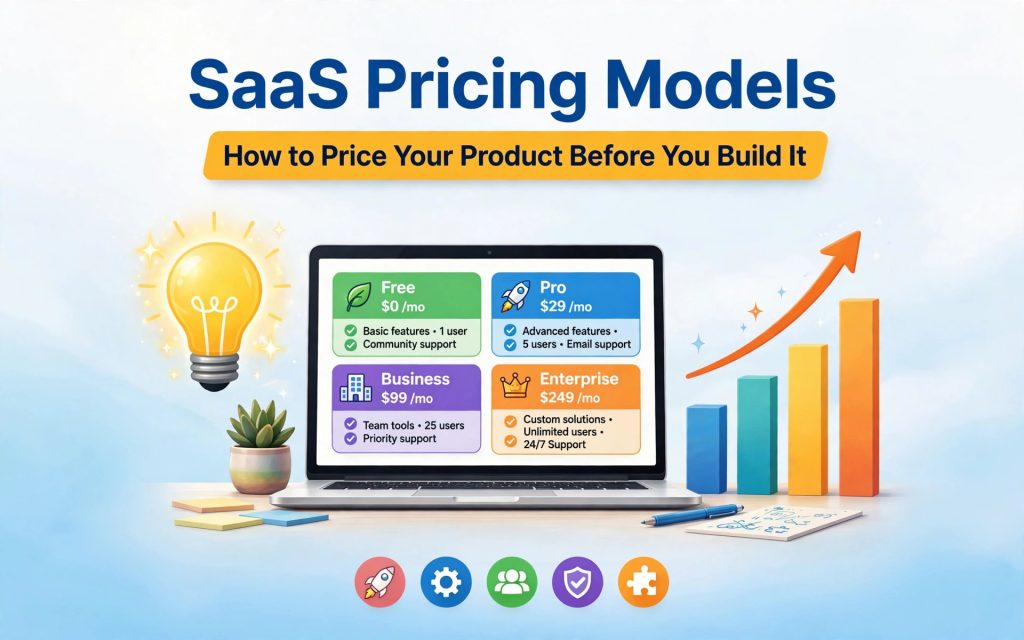
Three or four packages at fixed prices with escalating limits and features. This is the most common model because it captures different willingness to pay while keeping bills predictable.
The difficulty is choosing what gates each tier. Gate the wrong feature and you either block adoption or give away your differentiator.
Hybrid
A base platform fee plus usage above an included allowance. Most mature B2B SaaS converges here, because it gives you a predictable revenue floor and upside from growth.
It is also the heaviest to build, combining everything the models above require.
What each model costs to build
Rough incremental engineering effort on top of a product with no billing at all:
| Model | Build effort | What it requires |
|---|---|---|
| Flat rate | 1–2 weeks | Subscription, payment provider, basic account state |
| Per seat | 3–5 weeks | Invites, roles, seat counting, proration on change |
| Tiered | 4–7 weeks | Feature flagging, plan limits, upgrade and downgrade paths |
| Usage based | 8–14 weeks | Metering pipeline, aggregation, dashboards, caps, dispute handling |
| Hybrid | 10–16 weeks | All of the above combined |
Those numbers surprise most founders, and they are the reason this decision belongs in scoping rather than in a later marketing meeting. If you are putting a budget together, our breakdown of custom software development cost shows where this sits in a total build.
Choosing: three questions
What grows when the customer gets more value? Find the thing that increases as your product works better for them — users, transactions, properties managed, invoices processed. That is your natural pricing metric, and it should be something customers are happy to see grow.
Can the customer predict their bill? In B2B, procurement teams reject unpredictable costs. If your metric is volatile, add a cap, a commitment tier, or an allowance.
Can you measure it reliably today? A metric you cannot instrument accurately will produce billing disputes, and billing disputes destroy trust faster than a high price does.
Build this into the architecture from day one
Even if you launch on flat-rate pricing, three things should exist from the start, because adding them later means touching every part of the system:
- An event log of meaningful actions. Record what customers do, even if you do not bill for it yet. Without historical data you cannot model a usage price later.
- A feature flag layer. Gate capability by plan from the beginning, even with one plan. Retrofitting entitlement checks across a mature codebase is a multi-month job.
- Plan state separated from user state. Keep subscription and entitlement data distinct from user records. Conflating them is the most common reason pricing changes become rewrites.
This is the same principle covered in our guide on how to future-proof a software investment: the cheap decisions are the ones made before anything is built.
Common mistakes
Pricing against competitors instead of value. Undercutting is the easiest position to copy and the hardest to recover from.
Too many tiers. Beyond four, buyers stall. Decision paralysis costs more conversions than a slightly wrong price does.
Launching too cheap. Raising prices on existing customers is politically costly; most early-stage products are underpriced by a wide margin and discover it too late.
No annual option. Annual billing improves cash flow and cuts churn. Build it at launch, not in year two.
Frequently asked questions
Which SaaS pricing model is most common?
Tiered pricing, usually combined with per-seat within each tier. It balances revenue capture against buyer predictability, which is why most B2B products land there.
Can I change my pricing model later?
Yes, but it costs more than people expect — engineering work, migration of existing contracts, and customer communication. Grandfathering existing customers is normal and usually necessary.
Should I offer a free tier?
Only if your acquisition depends on self-service volume and your marginal cost per free user is genuinely low. For most B2B products a time-limited trial converts better and costs far less to support.
How does pricing affect the tech stack?
Usage-based pricing needs a metering and aggregation pipeline that flat-rate products never require. Our guide to choosing a tech stack for SaaS covers the architectural side.
Working out what to build to support your pricing? Book a 30-minute consultation and we will scope the billing layer honestly.