Every business that builds custom software hopes it will last. Yet many teams find that within three years their platform is slow, expensive to change, and hard to hire for. Learning how to future-proof your software investment is the difference between a system that grows with your company and one you have to rebuild from scratch. In this guide, we share the practical steps DevForc uses with clients to protect budgets, reduce technical debt, and keep software useful for the long term.
What Does It Mean to Future-Proof Your Software Investment?
Learning to future-proof your software investment does not mean predicting the future. No one knows which framework, device, or regulation will matter in five years. It means designing and managing software so it can adapt cheaply when things change. A future-proof product is easy to modify, easy to scale, secure by default, and not locked into a single vendor or technology.
To future-proof your software investment, think of it as lowering the cost of change. Software that costs little to change stays valuable. Software that costs a fortune to change becomes a liability, no matter how impressive it looked on launch day.
Why Software Fails to Last (and How to Future-Proof Your Software Investment)
Most software does not fail because of one big mistake. It ages because of many small decisions. The most common causes include:
- Rushed architecture: shortcuts taken to hit a launch date that later slow every new feature.
- Technical debt: messy code, missing tests, and outdated libraries that pile up unnoticed.
- Vendor lock-in: deep dependence on one cloud provider, tool, or agency that is costly to leave.
- No documentation: knowledge that lives in one developer’s head and leaves when they do.
- Unclear requirements: building features nobody uses while ignoring what customers actually need.
Understanding these causes helps you future-proof your software investment from day one.
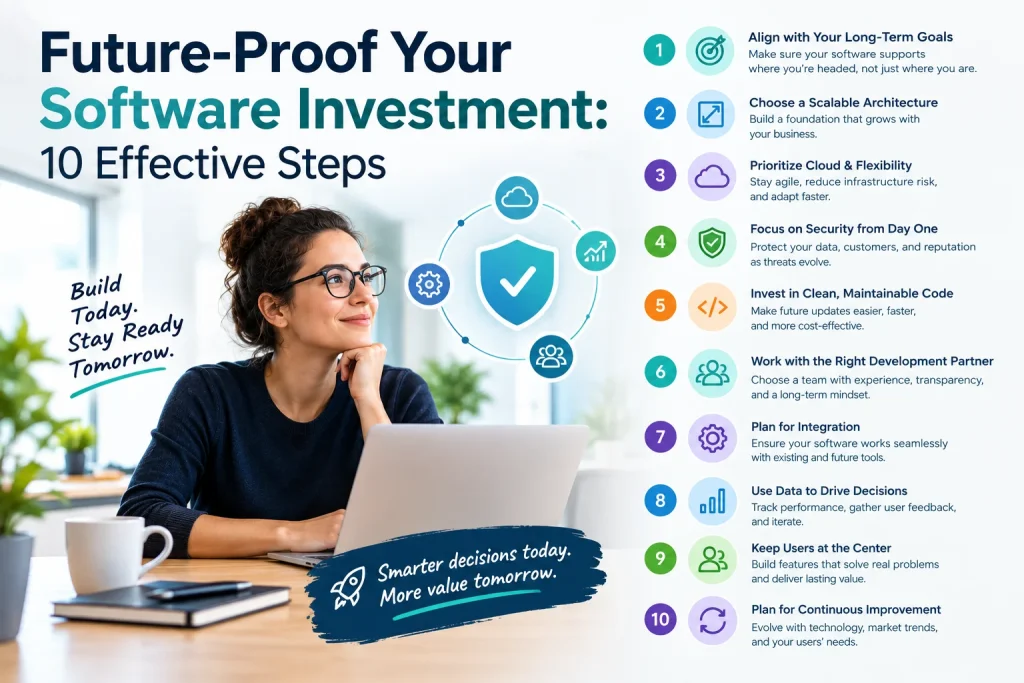
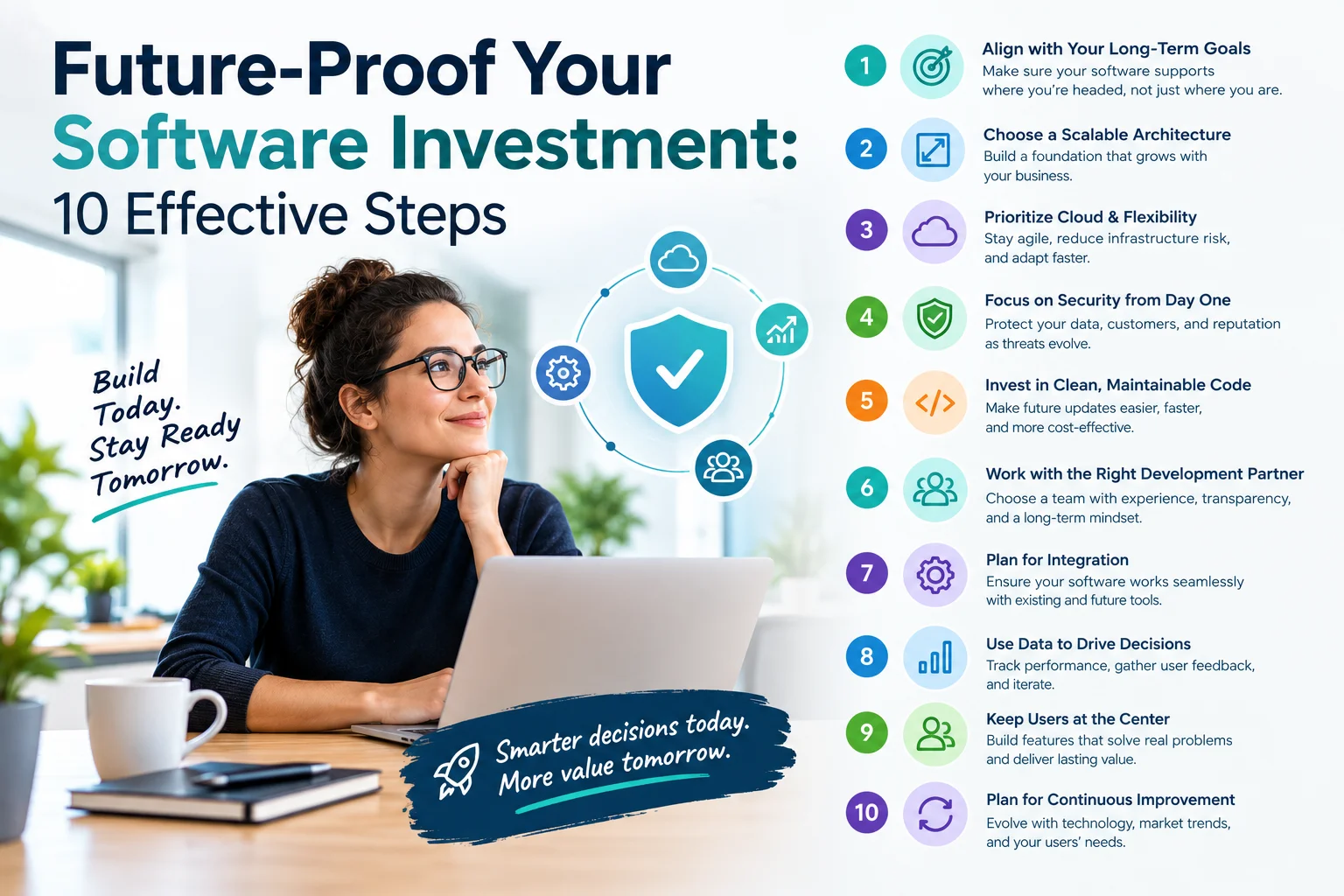
1. Start with Clear Business Goals, Not Features
Before writing a single line of code, define what business outcome the software must deliver. Do you want to reduce manual work, increase online sales, or improve customer retention? Goals give your team a filter for every decision. When a new feature does not support the goal, it waits.
A well-scoped minimum viable product (MVP) is one of the best ways to protect your budget, and our guide on MVP development: what to build first and what to cut explains how to scope it. Launch the core value first, learn from real users, and then invest in what proves useful. This keeps early costs low and avoids building a large product on assumptions.
2. Choose a Modern, Well-Supported Technology Stack
Your technology choices will shape your costs for years, which is why choosing between custom software and off-the-shelf tools matters early. Pick tools that have large communities, active maintenance, strong documentation, and a healthy pool of developers. Popular choices such as React, Node.js, Python, Laravel, and PostgreSQL are widely supported, which makes hiring and maintenance easier.
Avoid chasing trends. A brand-new framework may look exciting but can be abandoned within two years. Boring, proven technology is often the smartest long-term choice. When you evaluate a stack, ask three questions: Is it actively maintained? Can I easily find developers for it? Does it integrate with the tools I already use?
3. Build a Scalable and Modular Architecture
Scalability is not only about handling more users. It is about handling change. A modular architecture splits your software into independent parts, so you can update or replace one piece without breaking the rest.
Consider these approaches:
- API-first design: expose functionality through clean APIs so web, mobile, and third-party systems can all connect later.
- Modular monolith or microservices: start simple, and split into services only when scale demands it.
- Cloud-ready infrastructure: use containers and infrastructure as code so you can move or expand easily.
Not every project needs microservices. For many businesses, a well-organized modular monolith is cheaper and easier to maintain. The goal is flexibility, not complexity.
4. Avoid Vendor Lock-In
Relying heavily on a single vendor gives that vendor power over your pricing and roadmap. To protect yourself, use open standards, keep your data portable, and make sure you own your source code and documentation. Ask your development partner for full code ownership and access to repositories from the start.
Using cloud services is fine, but wrap them behind your own interfaces where possible. That way, switching providers later is a project, not a rewrite.
5. Prioritize Code Quality and Automated Testing
Clean code is cheaper to change. Insist on code reviews, consistent coding standards, and automated tests. Tests act as a safety net, letting developers add features or upgrade libraries without fear of breaking existing functionality.
A continuous integration and delivery (CI/CD) pipeline takes this further. It automatically tests and deploys changes, which reduces human error and speeds up releases. Teams with strong automation spend more time building value and less time fixing regressions.
6. Make Security and Compliance Part of the Design
Security added at the end is expensive and often incomplete. Build it in from the beginning with secure authentication, encrypted data, regular dependency updates, and role-based access control. Follow guidance such as the OWASP Top 10 to guard against common vulnerabilities.
Regulations like GDPR and regional data protection laws keep evolving. Software that handles personal data carefully and logs access properly will adapt to new rules far more easily than software that treats privacy as an afterthought.
7. Document Everything That Matters
Documentation is an insurance policy. Keep clear records of architecture decisions, setup instructions, API references, and deployment processes. When team members change, or you switch agencies, good documentation lets the next team become productive in days instead of months.
8. Plan for Maintenance from Day One
Software is not a one-time purchase; it is a living asset. A common rule of thumb is to budget roughly 15 to 20 percent of the original development cost each year for maintenance, updates, monitoring, and small improvements. Skipping this budget is the fastest way to accumulate technical debt. To plan the full budget, read our custom software development cost guide. A realistic maintenance plan is a core part of any effort to future-proof your software investment.
Schedule regular health checks: update dependencies, review performance, refactor problem areas, and retire unused features. Small, steady care is far cheaper than a major rescue project later.
9. Stay Flexible with Agile Development
Markets change, and so do customer needs. Agile development delivers software in short cycles, so you can adjust direction often. Regular demos, feedback loops, and prioritized backlogs ensure you keep building what matters. This approach limits wasted spend and keeps your product aligned with reality.
10. Choose the Right Development Partner
The team you work with matters as much as the technology. Look for a partner who asks about your business goals, explains trade-offs honestly, provides transparent estimates, and offers long-term support. Our checklist on how to hire a software development agency lists the questions to ask. Check their portfolio, client reviews, and how they handle testing, security, and handover.
At DevForc, we build custom software with scalability, code quality, and long-term maintainability in mind, so your investment keeps paying off as your business grows.
Future-Proof Your Software Investment: Quick Checklist
- Clear business goals and a scoped MVP
- Proven, well-supported technology stack
- Modular, API-first architecture
- Full ownership of code, data, and documentation
- Automated testing and CI/CD pipeline
- Security and compliance built in
- Annual maintenance budget
- Agile process with regular feedback
- A reliable long-term development partner
Frequently Asked Questions
How long should custom software last?
With good architecture and regular maintenance, custom software can serve a business for 10 years or more. Without maintenance, it may feel outdated in three to five.
Is it cheaper to rebuild or maintain old software?
Maintenance is usually cheaper if the core architecture is sound. A rebuild makes sense when the technology is obsolete, security risks are severe, or every change becomes prohibitively slow and costly.
How much should I budget for software maintenance?
Plan for about 15 to 20 percent of the initial build cost per year. Complex or fast-growing products may need more.
Does future-proofing make software more expensive upfront?
Slightly, in some cases, but the effort to future-proof your software investment pays for itself. Good architecture, testing, and documentation add early effort, but they dramatically reduce long-term costs and prevent expensive rewrites.
Final Thoughts
You cannot predict the future, but you can build software that is ready for it. To future-proof your software investment, focus on clear goals, proven technology, modular design, strong security, and steady maintenance. These habits protect your budget and keep your product competitive for years.
Planning a new product or worried about an aging system? Contact DevForc today for a free consultation, and let us help you build software that lasts.