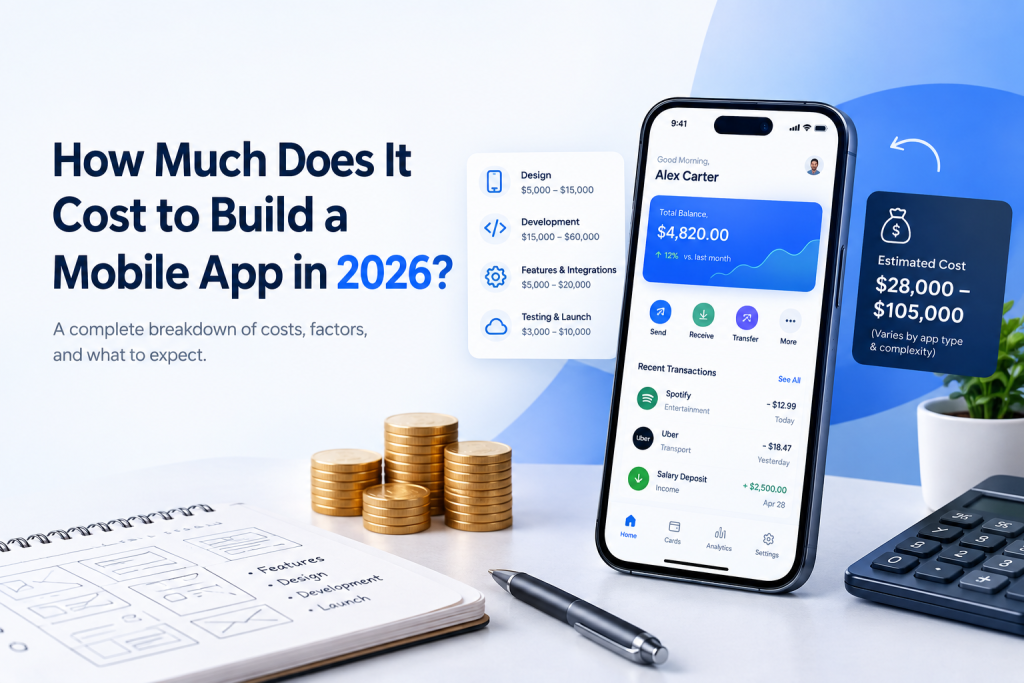
“How much will my app cost?” is the first question almost every founder asks us, and the honest answer is that the number depends less on the app than on the decisions you make before a single line of code is written. This guide breaks down what actually drives the cost of building a mobile app, what a realistic budget looks like at each level of ambition, and where teams most often overspend.
What actually drives app development cost
Development cost is a function of four things: scope, platform, design depth, and backend complexity. Everything else is a consequence of those four.
1. Scope: the number of user journeys, not the number of screens
Teams estimate in screens because screens are easy to count. But a screen that only displays data might take a day, while a screen with a payment flow, error states, retry logic, and receipt generation can take three weeks. Count complete user journeys instead: sign up, browse, purchase, refund, support. Each journey carries its own edge cases, and edge cases are where budgets go to die.
2. Platform: native, cross-platform, or both
Native development (Swift for iOS, Kotlin for Android) gives you the best performance and immediate access to new OS features, but you are effectively building twice. Cross-platform frameworks like React Native and Flutter let one team ship to both stores, which typically saves 30 to 40 percent versus two native builds. The tradeoff shows up when you need heavy animation, complex camera work, background processing, or tight hardware integration.
Our rule of thumb: if the app is content, commerce, or workflow driven, cross-platform is almost always the right call. If the app is the hardware experience, go native.
3. Design depth
Using a component library with light customisation is fast and cheap. A bespoke design system with custom illustration, motion, and a full accessibility pass costs considerably more and takes longer, but it is also what makes an app feel like a product rather than a template. Decide which one you are buying before you brief anyone.
4. Backend complexity
An app that reads from a simple API is a different project from one that needs real-time sync, offline-first behaviour, role-based permissions, third-party integrations, and an admin panel. The backend is invisible to your users and frequently accounts for close to half the build.
Three realistic budget tiers
Tier 1 — Validation MVP
One platform or cross-platform, three to five core journeys, off-the-shelf auth and payments, a managed backend, minimal custom design. Timeline is typically 8 to 12 weeks. The goal is not to launch a business, it is to find out whether anyone wants the thing. Most founders should start here and most do not.
Tier 2 — Market-ready product
Both platforms, a custom design system, a real backend with an admin panel, analytics, push notifications, proper QA, and app store optimisation. Timeline is typically 4 to 6 months. This is the tier where most funded startups land.
Tier 3 — Scale and complexity
Real-time features, offline sync, multiple user roles, enterprise integrations, compliance requirements, and infrastructure built for load. Timeline runs 6 to 12 months and the work rarely stops at launch.
The costs founders forget to budget for
- App store fees. Apple charges an annual developer fee; Google charges a one-time registration fee. Both take a commission on in-app purchases.
- Infrastructure. Hosting, databases, file storage, and third-party APIs are a recurring monthly cost that scales with your users.
- Maintenance. iOS and Android ship major versions every year. Budget roughly 15 to 20 percent of the original build cost annually just to keep the app working.
- Post-launch iteration. Your first release is a hypothesis. The budget that matters is the one that funds the next three months of changes based on what real users do.
How to keep the number down without gutting the product
Cut features, not quality. A smaller app that works flawlessly beats a large one that is half-finished in every dimension that matters: reviews, retention, and word of mouth.
Ship one platform first. Pick whichever platform your target users actually carry, learn from it, then port. You will build the second version faster and better because you will know what to change.
Buy instead of build wherever the thing is not your differentiator. Authentication, payments, push notifications, analytics, and customer support all have mature providers. Building your own is almost never worth it.
Invest in discovery. A two-week discovery phase that kills the wrong feature pays for itself several times over. This is exactly why our product strategy work comes before development rather than alongside it.
Getting an estimate you can actually trust
Any agency that quotes a firm number from a one-paragraph brief is guessing, and you will pay for that guess later in change requests. A trustworthy estimate comes with its assumptions written down, a range rather than a single figure, and a clear statement of what is out of scope.
If you are weighing up a build, tell us what you are trying to launch and we will walk you through the scope, the tradeoffs, and a realistic range before anyone talks about a contract. You can also see how we have approached similar builds.